Core Materials: Leather strips, hemp ropes, plant fibers, and simple iron wires.
Connection Method: Wrap leather or hemp rope around the pipeline joint and tie it tightly; or wrap thin iron wire repeatedly and tighten it to fix hoses and hard pipes by friction.
Limitations: Prone to corrosion and loosening, with extremely poor sealing, and leakage was common; it could only be used in low-pressure scenarios such as water transportation and ventilation, with a short service life and frequent maintenance requirements.
Milestone: Around 1500, Leonardo da Vinci designed a leather diving breathing tube, using annular reinforcement to support the tube wall, which is regarded as the early prototype of pipeline fastening structures. After the birth of canvas hoses in the 17th century and vulcanized rubber hoses in the 19th century, iron wire binding became mainstream, but the problems of sealing and durability remained unsolved.
First-Generation Metal Fasteners (Late 19th Century): Flat steel belts with saddles and cotter pins, known as "hose binders". They wrapped the pipeline with metal belts and fixed it with cotter pins, with fastening force far exceeding that of iron wire, but the installation was cumbersome and non-adjustable.
Emergence of Hose Clamp Prototypes (1910–1920): In 1918, Berlin-based German manufacturer Franz Sauerbier exhibited a special clamp for garden hoses, whose structure was highly similar to modern hose clamps. In the same period, Britain invented the worm-drive hose clip, with the core of "steel belt + worm". Rotating the worm drives the steel belt to shrink, which is adjustable and reusable, laying the foundation for modern hose clamps.
Application Scenarios: Steam locomotive pipelines, ship pipelines, and early automotive cooling systems, solving the leakage problem under high pressure and vibration.
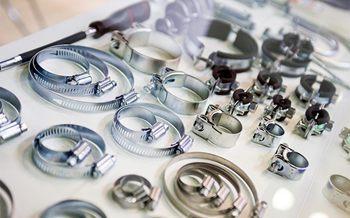
Worm-Drive Hose Clamps (Mainstream): Toothed steel belt meshed with worm, with a large adjustment range and strong locking force. It is suitable for automobiles, home appliances, and industrial pipelines, and is still the most widely used today.
Spring Hose Clamps (Constant Tension): Open rings made of spring steel, which expand by pinching the ear pieces. After being sleeved, they clamp tightly by spring tension, automatically compensating for thermal expansion and contraction with uniform pressure, suitable for automotive cooling and fuel systems.
Steel Wire Hose Clamps (Economical Type): Double steel wire bent rings locked by screws, lightweight and low-cost, suitable for low-pressure ventilation and household water pipes, but prone to cutting hoses with small locking force.
Heavy-Duty Hose Clamps: Widened and thickened steel belts with thickened bolts, with locking force up to several hundred Newtons, suitable for construction machinery and hydraulic pipelines, preventing loosening and leakage.
1920s – 1940s: Galvanized iron was the main material, with weak rust resistance, short service life, and easy rusting and jamming.
1950s – 1970s: Stainless steel (304/316) and alloy steel became popular, featuring corrosion resistance, high strength, and aging resistance, suitable for chemical, marine, and outdoor scenarios; some high-end products were equipped with rubber gaskets to enhance sealing and protect hoses.
Boom of China's Industry (1980s – 2010s): After the reform and opening up, industrial clusters formed in Tianjin, Zhejiang, Jiangsu and other places. For example, Yanzhuang Town, Jinghai, Tianjin, had more than 80 enterprises with an annual output of billions of hose clamps, accounting for more than 50% of the domestic market and more than 30% of the international market, with an annual output value exceeding 1 billion yuan. After 2005, local enterprises broke through technical bottlenecks, and stainless steel hose clamps and heavy-duty hose clamps realized import substitution, with a price only 1/3 of imported products, showing significant cost performance advantages.
Process Upgrade: Full-process numerical control (stamping, bending, welding, passivation), with the production capacity of a single line jumping from 3 million pieces per year to 12 million pieces; the product precision reached ±0.1mm, and structures such as anti-slip teeth and anti-loosening nuts were optimized, reducing the leakage rate to below 0.1%.
Full Application Coverage: Automobiles (cooling, air intake, fuel systems), home appliances (washing machines, water heaters), construction machinery, petrochemical industry, ships, new energy equipment, etc., becoming the "standard configuration" for pipeline connections.
High-Pressure/Ultra-High-Pressure Hose Clamps: Suitable for hydrogen energy and hydraulic systems, with a locking force of more than 1000N and a temperature resistance of -40℃ ~ +200℃.
Corrosion-Resistant Hose Clamps: Made of duplex stainless steel and titanium alloy, suitable for marine and chemical strong corrosion environments.
Quick-Install/Tool-Free Hose Clamps: Buckle design, no tools required, one-second installation, suitable for rapid maintenance scenarios.
Rise of Intelligent Hose Clamps: Built-in sensors to real-time monitor sealing pressure, temperature, and vibration, transmit data wirelessly, and issue abnormal warnings, suitable for aerospace, nuclear power, and smart factories, realizing "predictive maintenance".
Green Manufacturing: Cyanide-free galvanizing and environmental protection passivation processes to reduce pollution; recyclable stainless steel materials, meeting the requirements of carbon neutrality.
Era | Core Demand | Technical Characteristics | Representative Products |
|---|---|---|---|
Before the 19th Century | Low-pressure fixation, low cost | Natural materials, manual binding, no standards | Iron wire ties, hemp rope binding |
Late 19th Century – Early 20th Century | High-pressure sealing, adjustable | Metal materials, worm structure, prototype of standardization | First-generation worm hose clamps, flat steel belt binders |
1920s – 1970s | Multi-scenario adaptation, durability | Structural differentiation, stainless steel materials, anti-loosening design | Spring hose clamps, steel wire hose clamps, galvanized worm hose clamps |
1980s – Early 21st Century | Mass production with low cost, high precision | Automated production, import substitution, clustering | Domestic stainless steel worm hose clamps, heavy-duty hose clamps |
2010s – Present | Special working conditions, intelligent monitoring | New materials, sensor integration, green manufacturing | High-pressure special hose clamps, intelligent sensing hose clamps |
address
No 19, Guanghai Road, Jinghai new
economic developed zone, Tianjin city
telephone
86-022-68771238
86-022-68772466
86-022-68771191
tjbc@tjbchg.com