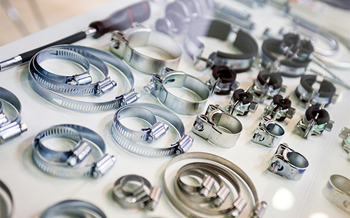
Hose clamps are basic fasteners used in automotive, machinery, chemical, food, marine, aerospace, municipal, household appliances and dozens of other industries. Each scenario has completely different requirements for sealing, fastening, weather resistance, installation, and cost.
Pressure difference: Low pressure (water pipes), medium pressure (oil pipes), high pressure (hydraulic/chemical)
→ Require heavy-duty, T-bolt, high-torque clamps.
Temperature difference: Normal, high temperature (engine/boiler), low temperature (refrigeration)
→ Need high-temperature resistant stainless steel, special alloys.
Corrosive environment: Fresh water, seawater, acid, alkali, oil, gas, food contact
→ Correspond to galvanized, 304/316 stainless steel, titanium alloy, food-grade materials.
Vibration and movement: Engine compartments, compressors, ships
→ Need spring clamps, flexible clamps to automatically compensate for thermal expansion and vibration.
Space and installation: Narrow cabins, quick maintenance, mass assembly
→ Correspond to single-ear/double-ear, quick-release, worm-driven infinitely adjustable clamps.
Medium and hygiene: Drinking water, food, pharmaceuticals, high-purity gas
→ Must use sanitary-grade, crevice-free, easy-to-clean special clamps.
Worm drive (American type): Infinitely adjustable, wide range, most universal → mainstream.
Bolt type (European/German type): Wide band, high torque, strong sealing → thick-walled hoses, high pressure.
T-bolt / Heavy-duty: Extra-large clamping force → heavy industry, turbocharging.
Spring type: Self-adaptive, anti-loosening → frequent vibration/temperature changes.
Single-ear / Double-ear / Wire: Quick installation, small diameter → automotive, appliances, flexible pipes.
Quick-release / Lever type: Tool-free, fast assembly → frequent maintenance.
Carbon steel / Galvanized: Low cost, sufficient strength → indoor, dry, low-pressure, general use.
304/316 Stainless Steel: Corrosion-resistant, easy to clean → wet, acid, food, medical, outdoor.
Special alloys (titanium, nickel-based, copper): Ultra-high temperature, strong corrosion → aerospace, chemical, marine.
Plastic / Nylon: Insulated, lightweight → small diameter, low pressure, non-load-bearing.
Surface treatment: Galvanizing, Dacromet, passivation → improve rust resistance, extend life.
Wide diameter range: From a few millimeters (appliances/auto) to hundreds of millimeters (industrial pipes)
→ Must be divided into detailed specifications.
Band width / thickness: Narrow (general), wide (heavy-duty), thickened (high-pressure)
→ Match pressure and hose wall thickness.
Customization: Special diameters, special interfaces → many customized clamps.
National standards: American, European, German, Japanese, Chinese
→ Different structures, dimensions, torques → American, European, German, British styles.
Industry-specific: Automotive, food, medical, marine, aerospace
→ Further divided into sanitary, automotive, marine, aerospace grades.
Cost and performance: High-end, mid-range, economy → meet different budgets.
address
No 19, Guanghai Road, Jinghai new
economic developed zone, Tianjin city
telephone
86-022-68771238
86-022-68772466
86-022-68771191
tjbc@tjbchg.com