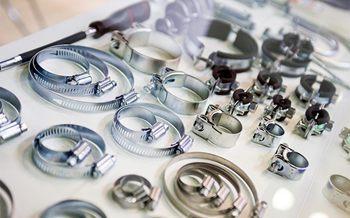
Hose clamps (also known as hose clips) are core fasteners for pipeline connections, and their material directly determines the clamping strength, corrosion resistance, applicable environment and service life. At present, the mainstream hose clamp materials on the market can be divided into three categories: stainless steel, carbon steel (including galvanized), and plastic. In addition, special materials such as titanium alloy and nickel-based high-temperature alloy are used in high-end extreme scenarios. Each has unique characteristics to adapt to different needs, and has become an indispensable connecting accessory in industrial, civil, automotive and other fields.
Stainless steel hose clamps are the mainstream choice in the market, accounting for more than 60%. The subdivided materials are mainly 201, 304 and 316. 201 stainless steel hose clamps have outstanding cost performance and good mechanical strength, suitable for fixing low-pressure pipelines in dry indoor environments; 304 stainless steel hose clamps have balanced comprehensive performance, resistance to moisture and weak corrosion, and are suitable for humid environments, outdoor light rain scenarios and food-grade pipelines, making them the most widely used model; 316 stainless steel hose clamps add molybdenum element, which is resistant to strong acids, strong alkalis and seawater corrosion, and has better high-temperature resistance, suitable for high-pressure and strong corrosion scenarios such as marine engineering and chemical pipelines.
Carbon steel hose clamps focus on economical needs, using Q235 low-carbon steel as the base material, divided into ordinary carbon steel and galvanized carbon steel. Ordinary carbon steel hose clamps have extremely low cost, suitable for short-term use scenarios such as temporary construction site pipelines and exhaust belts, but they are prone to rust and have a short service life; galvanized carbon steel hose clamps improve basic rust resistance through surface galvanizing, suitable for dry and slightly humid environments, and the price is between ordinary carbon steel and 201 stainless steel, suitable for low-pressure scenarios sensitive to cost.
Plastic hose clamps are mainly made of nylon, with significant lightweight advantages. Their weight is only 20%-30% of that of metal hose clamps, and they have good electrical insulation, no rust, and convenient installation. They can be disassembled without special tools, suitable for fixing pipelines with low-pressure, non-corrosion and lightweight needs such as electronic equipment and communication equipment. However, their high-temperature resistance and strong corrosion resistance are weak, so they are not suitable for high-pressure and high-temperature scenarios.
In addition, special material hose clamps such as titanium alloy and nickel-based high-temperature alloy are designed for extreme working conditions, with outstanding lightweight, high-temperature resistance and high-pressure resistance. They are mainly used in high-end fields such as aerospace, petrochemical industry and nuclear industry. Although they are expensive, they can solve the extreme scenario needs that traditional materials cannot adapt to, and provide guarantee for the stable operation of high-end equipment.