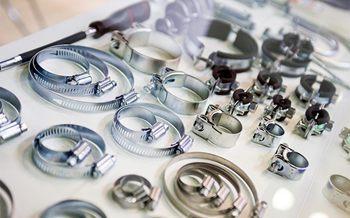
The core of custom hose clamps is to adapt to the actual use scenario, installation requirements and working conditions. Providing accurate parameters is the key to ensuring the adaptability, safety and practicality of custom products. It can effectively avoid problems such as inconsistent size, substandard performance and inconvenient installation, so that the custom hose clamps can perfectly match the pipeline connection needs and improve the connection stability and service life.
Basic specification parameters are the premise of customization. Customers need to first provide the clamping inner diameter range, clarify the actual outer diameter of the hose or pipeline adapted to the hose clamp, mark the "minimum inner diameter - maximum inner diameter", and it is recommended to reserve 1-2mm adjustment margin to prevent damage to the pipeline due to over-tightening or failure to seal due to over-loosening. At the same time, it is necessary to clarify the steel strip specifications, including the width and thickness of the steel strip, both of which directly determine the clamping force of the hose clamp. For high-pressure and heavy-load scenarios, wider and thicker steel strips should be selected. In addition, it is necessary to clarify the structural type of the custom hose clamp, such as German, British, American, etc. Different types have different locking principles and installation methods, and the adaptation scenarios are also different.
Material and surface treatment parameters determine the service life of the hose clamp. Customers need to select the core material according to the use environment, such as 201/304/316 stainless steel, carbon steel, nylon, etc. For humid and corrosive environments, 304 or 316 stainless steel is preferred, and nylon material can be selected for lightweight scenarios. If carbon steel or ordinary stainless steel is selected, the surface treatment method should be specified, such as electrogalvanizing, hot-dip galvanizing, polishing, etc., to improve rust and corrosion resistance.
Working condition and performance requirement parameters are related to use safety. Customers need to clarify the working pressure, working temperature and medium characteristics. The working pressure needs to be divided into low pressure, medium pressure and high pressure. For high-pressure scenarios, reinforced hose clamps need to be customized; the working temperature needs to provide the long-term use temperature range, and high-temperature resistant materials need to be selected for high-temperature scenarios; the medium characteristics need to explain the medium transported by the pipeline, such as oil, water, acid-base solution, etc., to avoid failure caused by reaction between the material and the medium.
In addition, customers also need to provide appearance and installation requirements, such as custom color, logo requirements, installation method, installation space limit, etc., and clarify the custom batch and delivery requirements, including quantity, delivery cycle, packaging method and acceptance standard. If some parameters cannot be clarified, the use scenario can be described in detail, and the manufacturer will recommend suitable parameters and materials according to the scenario to ensure that the custom product meets the expected needs.