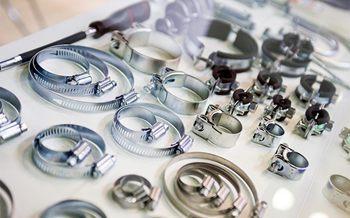
Many users ignore daily maintenance after installing hose clamps, leading to premature rusting, loosening and failure of hose clamps, which not only increases replacement costs but also may cause potential pipeline safety hazards. In fact, the service life of hose clamps depends not only on material and process but also on daily maintenance. At the same time, mastering common fault troubleshooting skills can quickly solve problems during the use of hose clamps and avoid the expansion of faults. Today, we will share professional skills for daily maintenance and fault troubleshooting of hose clamps to help you extend the service life of hose clamps and ensure pipeline safety.
First of all, the core points of daily maintenance: regular inspection, cleaning and rust prevention. The frequency of regular inspection depends on the scenario. For industrial scenarios, it is recommended to inspect once a month; for household scenarios, once a quarter. The key is to check the locking force of the hose clamp, whether the steel strip is rusted, whether the teeth are slipping, and whether there are signs of pipeline leakage. If loose locking is found, it needs to be tightened in time; if rust is found on the surface of the steel strip, it needs to be polished clean with sandpaper and coated with anti-rust agent to avoid the spread of rust; if the scenario is humid and highly corrosive, the inspection frequency needs to be increased, and the dust and medium residues on the surface of the hose clamp should be cleaned regularly to keep the surface dry.
Secondly, the maintenance focus of hose clamps of different materials is different. For carbon steel hose clamps, it is necessary to focus on rust prevention and maintenance, avoid long-term exposure to humid environments, and if not used for a long time, apply anti-rust oil and store in a sealed manner; 304/316 stainless steel hose clamps, although having strong corrosion resistance, also need regular cleaning to avoid long-term adhesion of corrosive media on the surface, which affects the service life; for hose clamps in high-temperature scenarios, it is necessary to regularly check for softening and deformation. If any abnormality is found, replace them in time to avoid safety hazards caused by high temperature.
Then, common fault troubleshooting and solution skills to accurately solve use problems. Fault 1: The hose clamp is not locked tightly, resulting in leakage. Troubleshooting reasons: either improper selection, mismatching between the diameter of the hose clamp and the pipeline; or slipping teeth, unsmooth worm transmission; or oil stains and impurities on the pipeline surface, leading to poor fitting. Solution: Replace the hose clamp with the appropriate specification, check the worm and teeth, replace the hose clamp if slipping occurs, clean the pipeline surface, and ensure tight fitting before locking.
Fault 2: The hose clamp is rusted or broken. Troubleshooting reasons: mismatching between material and scenario, such as selecting carbon steel hose clamps for corrosion scenarios; insufficient daily maintenance, long-term exposure to humid and corrosive environments; inferior hose clamp material that does not meet the standards. Solution: Replace the hose clamp with the appropriate material, strengthen daily rust prevention and maintenance, and select high-quality and up-to-standard hose clamps. Fault 3: The hose clamp damages the pipe wall. Troubleshooting reasons: narrow bandwidth, excessive locking force; burrs on the surface of the hose clamp; soft pipeline material, failure to select the appropriate hose clamp. Solution: Replace the hose clamp with a wider bandwidth, adjust the locking force, select a hose clamp with a smooth surface and no burrs, and use a protective gasket for hose scenarios.
Our hose clamps are not only of excellent material and precision craftsmanship but also provide professional after-sales maintenance guidance. According to different scenarios, we provide customized maintenance plans for users, and also provide common fault troubleshooting support to help you extend the service life of hose clamps and reduce maintenance costs. Choosing us, you can not only get high-quality hose clamp products but also professional technical support, making pipeline fastening more worry-free and assured.