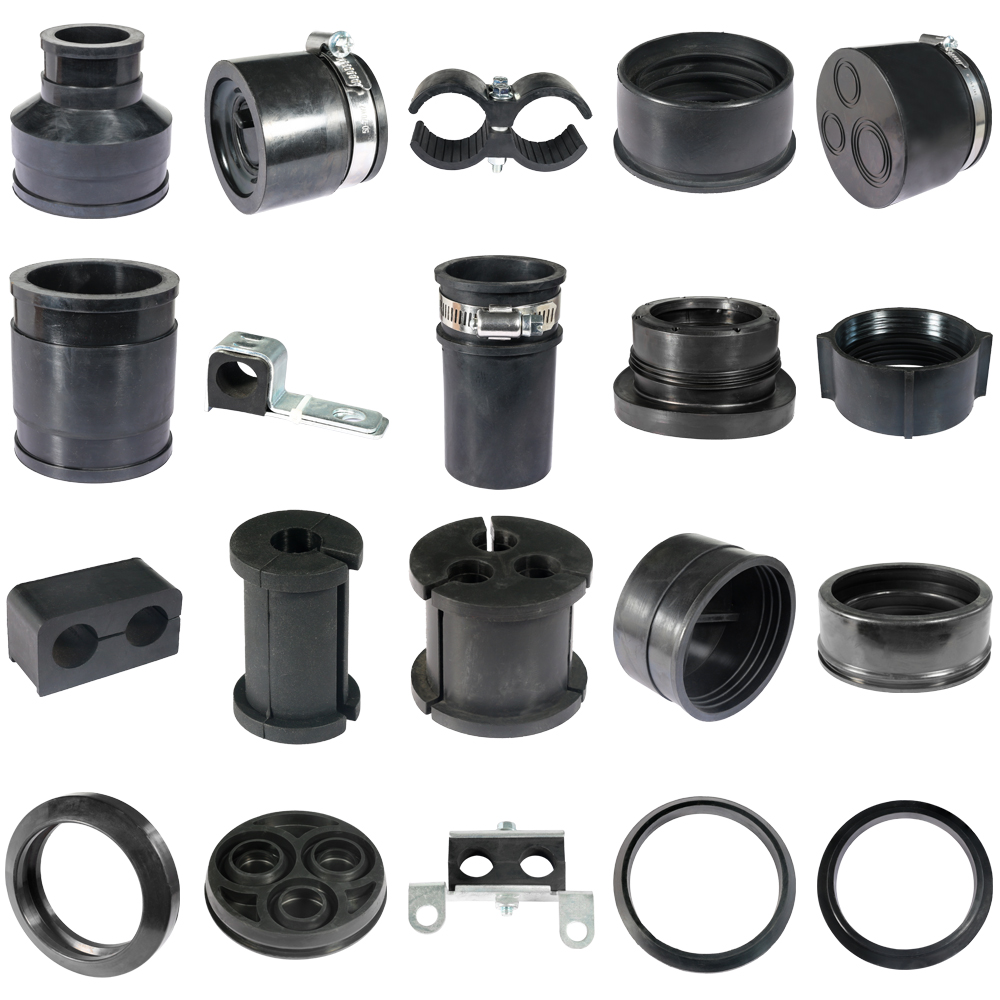
Special-shaped rubber products refer to non-standard, irregularly shaped rubber products whose size, structure and performance need to be customized according to specific scenarios. They are widely used in automotive, aerospace, medical, electronic, construction and many other fields. Their production process is characterized by professionalism, complexity and customization, focusing on the three core aspects of "raw material adaptation - precise molding - strict quality control". Details need to be controlled throughout the process to ensure that the products meet the design requirements and service conditions.
I. Pre-production Preparation
1. Raw Material Selection and Formula Design
Raw materials are the foundation of the performance of special-shaped rubber products. It is necessary to select suitable rubber substrates and additives according to the product's service environment (such as temperature, pressure, medium corrosion) and mechanical requirements (such as elasticity, hardness, wear resistance) to ensure that the products can work stably for a long time. Common rubber substrates include Natural Rubber (NR), Nitrile Butadiene Rubber (NBR), Ethylene Propylene Diene Monomer (EPDM), Fluororubber (FKM), Silicone Rubber, etc. Different substrates have significant characteristic differences. For example, fluororubber has strong resistance to high and low temperatures and corrosion, making it suitable for harsh working conditions; silicone rubber is non-toxic and flexible, often used in medical and food-contact products; EPDM has excellent aging resistance and weather resistance, and is widely used in the field of automotive seals.
The proportion of additives directly affects product performance. It is necessary to scientifically match vulcanizing agents, accelerators, fillers, anti-aging agents, etc. according to the substrate characteristics and product requirements. For example, vulcanizing agents can cross-link rubber molecules from a linear structure to a three-dimensional network structure, endowing the product with elasticity and strength; fillers (such as carbon black, white carbon black) can improve product hardness and wear resistance, while reducing production costs; anti-aging agents can delay rubber aging and extend product service life. Formula design needs to go through multiple tests and adjustments to ensure that various performance indicators (such as hardness, tensile strength, elongation) meet the standards, while taking into account production feasibility to avoid problems such as uneven mixing and abnormal vulcanization. Some enterprises also filter raw material impurities through multi-layer filters to further improve raw material purity and lay a foundation for subsequent production.
2. Mold Design and Manufacturing
Special-shaped rubber products have irregular shapes, and the mold is the core tool for molding. Its design and manufacturing accuracy directly determine the dimensional error and appearance quality of the product. Mold design must strictly follow the drawings or samples provided by the customer, clarify the product's contour, dimensional tolerance, wall thickness, chamfer and other details, and reserve a reasonable shrinkage margin combined with the rubber's shrinkage characteristics (usually the shrinkage rate is 2%-5%) to avoid dimensional deviation and deformation of the product after molding. For special-shaped parts with complex structures, it is necessary to design parting surfaces and exhaust holes to ensure that the rubber compound can uniformly fill the mold cavity and discharge air, preventing defects such as bubbles and missing glue in the product.
Mold manufacturing mostly uses high-quality steel (such as Cr12MoV), and goes through multiple processing procedures such as turning, milling, grinding, and electrical discharge machining to ensure that the mold cavity surface is smooth and the size is accurate. The tolerance needs to be controlled within ±0.05mm, and some high-precision products even require a tolerance of ≤±0.02mm. The mold surface needs to be polished, nitrided and other treatments to improve wear resistance and demolding performance, and reduce problems such as product sticking to the mold and scratches. For small-batch, multi-variety customized orders, flexible molds or vibration knife cutting can be used without making special steel molds, reducing production costs and cycles, and adapting to the needs of rapid prototyping.
3. Equipment Debugging and Process Parameter Determination
The production of special-shaped rubber products requires a variety of special equipment. The core equipment includes mixing machines, preforming machines, vulcanizing machines, trimming machines, etc. Some high-precision products also require injection molding machines, CNC cutting machines, etc. Before production, all equipment must be fully debugged to check the equipment operation status, accuracy and safety to ensure that the equipment can operate normally. For example, the mixing machine needs to adjust the speed and temperature to ensure uniform mixing of the rubber compound; the preforming machine needs to calibrate the weight accuracy of the rubber blank, which can be stably controlled within ±1% to ensure that the rubber blank has a good volume forming, no burrs and no air; the vulcanizing machine needs to adjust core parameters such as temperature, pressure and time to ensure stable and controllable vulcanization process; the injection molding machine needs to adjust the injection pressure and holding time to adapt to the fluidity requirements of the rubber compound.
The determination of process parameters needs to be optimized through small-batch trial production combined with raw material formula, mold structure and product performance requirements. For example, the vulcanization temperature must be determined according to the rubber substrate. The temperature of natural rubber is usually about 150℃, while that of nitrile rubber and fluororubber needs to be appropriately increased; the vulcanization pressure needs to overcome the expansion force of the rubber compound, generally 10-50MPa, to prevent bubbles and flash in the product; the vulcanization time needs to reach the positive vulcanization point to avoid under-vulcanization (insufficient product elasticity and low strength) or over-vulcanization (product brittleness and easy aging). At the same time, it is necessary to determine the process parameters of preforming, demolding, cooling and other links to ensure the smooth connection of each link and improve production efficiency and product consistency.
II. Core Production Process
1. Rubber Compound Mixing
Mixing is the process of uniformly mixing rubber substrates and additives to form a mixing compound with consistent performance, which is a key link to ensure the uniformity of product performance. Mixing is divided into open mixing and closed mixing. At present, closed mixing machines are mostly used in industrial production, which have high mixing efficiency, good rubber compound uniformity and can reduce dust pollution. During the mixing process, it is necessary to strictly control the temperature (usually 50-80℃; too high temperature is easy to cause scorching of the rubber compound, and too low temperature will lead to uneven mixing) and time. First, soften the rubber substrate, then add vulcanizing agents, accelerators, fillers and other additives in turn, and gradually mix them uniformly to finally form a mixing compound with uniform texture, no agglomeration and no impurities. Some high-end equipment also integrates vacuum pumping and filtering functions, which can remove air and impurities from the rubber compound during the mixing process, further improving the quality of the mixing compound and reducing the defect rate of subsequent products.
2. Rubber Blank Preforming
Rubber blank preforming is the process of processing the mixing compound into a blank similar to the shape and size of the mold cavity, which is convenient for subsequent mold filling, improving molding efficiency and product accuracy. Preforming can use preforming machines, extruders and other equipment, and select appropriate processing methods according to the product shape: for complex strip, annular and three-dimensional rubber blanks, ECO series preforming machines can be used, which integrate extrusion, cutting, weighing, counting and other functions, and can achieve high-precision blank making. The weight accuracy of the rubber blank is stably controlled within ±1%, with no breakpoints and no edge material, reducing material waste; for simple special-shaped parts, it can be cut after extrusion by an extruder or made into rubber blanks by manual cutting. The preformed rubber blank needs to be preheated to soften the rubber compound, improve its fluidity, facilitate filling the mold cavity, and reduce bubbles and missing glue during the molding process.
3. Molding and Vulcanization
Molding and vulcanization is the core link in the production of special-shaped rubber products. Through the synergistic effect of the mold and vulcanization equipment, the rubber blank undergoes a vulcanization reaction under high temperature and high pressure to form a product with a fixed shape and stable performance. According to the product structure and batch requirements, there are mainly 3 common molding and vulcanization methods:
Compression Molding Vulcanization: Suitable for special-shaped parts with complex shapes, high dimensional accuracy and large batches, such as automotive shock absorbers and seals. Put the preformed rubber blank into the preheated mold cavity, apply pressure (10-50MPa) after clamping the mold, and control the vulcanization temperature and time at the same time, so that the rubber compound is fully vulcanized and cross-linked in the mold to form a product consistent with the mold cavity. The advantages of compression molding vulcanization are high product accuracy and stable performance, while the disadvantages are long production cycle (5-30 minutes per mold) and high mold cost.
Injection Vulcanization: Suitable for high-precision, complex-structured special-shaped parts, such as medical rubber products and automotive precision seals. Use a rubber injection molding machine to plasticize the mixing compound, inject it into the mold cavity at high pressure through the injection system, and then complete the vulcanization in the mold. The advantages of injection vulcanization are high automation, high production efficiency (mold cycle ≤5 minutes), and high product accuracy (dimensional error ≤±0.05mm), while the disadvantages are high equipment cost and high requirements for the fluidity of the rubber compound.
Extrusion Vulcanization: Suitable for long strip and continuous special-shaped parts, such as special-shaped sealing strips and hoses. Extrude the mixing compound into the required special-shaped cross-section through an extruder, then enter a continuous vulcanization equipment (such as steam vulcanization tank, microwave vulcanization machine) for vulcanization to form a continuous special-shaped product, and finally cut it into the specified length according to requirements. The advantages of extrusion vulcanization are high production efficiency and continuous production, while the disadvantage is relatively low product accuracy, which is suitable for special-shaped parts with relatively simple shapes.
During the vulcanization process, it is necessary to real-time monitor core parameters such as temperature, pressure and time. Once parameter deviation occurs, it is necessary to adjust in time to avoid defects such as bubbles, missing glue, deformation, over-vulcanization or under-vulcanization of the product. Some enterprises use MES system to realize real-time monitoring of process parameters. When the parameters deviate from the set range, the system automatically alarms and triggers shutdown, effectively reducing the scrap rate.
4. Demolding and Post-processing
After vulcanization is completed, demolding must be carried out in time. During demolding, attention should be paid to operating specifications to avoid product deformation and scratches due to excessive force. For products sticking to the mold, mold release agent can be applied to the mold surface or cooling demolding can be adopted to reduce mold sticking. The demolded product needs to be cooled and shaped, usually by natural cooling or cold water cooling, to quickly reduce the product temperature to room temperature, fix the product shape and reduce deformation.
After cooling, the product needs post-processing, the core of which is trimming and polishing: remove flash, burrs, excess glue, etc. on the product surface to ensure the product has a clean appearance and accurate size. Trimming can adopt manual trimming, mechanical trimming (such as trimming machine), cryogenic trimming and other methods. Among them, cryogenic trimming has high efficiency and good trimming effect, which is suitable for mass production. It can effectively remove fine flash without damaging the product surface. For products with special requirements, surface treatment (such as grinding, polishing, spraying) is also required to improve the surface finish and wear resistance of the product, or secondary vulcanization is performed to further improve product performance.
III. Quality Inspection and Control
The quality of special-shaped rubber products directly affects their use effect and service life. It is necessary to establish a full-process quality inspection system covering raw materials, production processes, finished products and other links to ensure that the products meet design standards and industry specifications (such as GB/T, ISO related standards).
1. Raw Material Inspection
Before raw materials enter the factory, it is necessary to strictly inspect the rubber substrates and additives to ensure that their various indicators meet the formula requirements. For example, test the Mooney viscosity, volatile matter, ash content, etc. of the rubber substrate; test the purity and melting point of vulcanizing agents and accelerators; test the particle size and dispersibility of fillers. Use equipment such as infrared spectroscopy (IR), thermogravimetric analysis (TGA), and laser particle size analyzer for testing. Unqualified raw materials are strictly prohibited from entering the factory to control product quality from the source. Some enterprises have established a raw material traceability system, and each batch of raw materials has a qualification certificate to ensure that the raw material quality is traceable and controllable.
2. In-process Inspection
During the production process, it is necessary to conduct real-time inspection of each link to find and solve problems in time. For example, in the mixing link, test the uniformity and hardness of the mixing compound to ensure consistent rubber compound performance; in the preforming link, test the size and weight of the rubber blank to control the error within the allowable range; in the vulcanization link, test the temperature, pressure and time to ensure stable vulcanization process; after demolding, test the appearance and size of the product to timely eliminate unqualified products such as deformation, missing glue and bubbles. At the same time, regularly check the equipment operation status to ensure equipment accuracy and avoid product quality problems caused by equipment failures. Some enterprises set up multiple quality inspection stations in the production process, and each station has quality inspectors to achieve full-process monitoring.
3. Finished Product Inspection
Finished product inspection is the last line of defense before the product leaves the factory. It is necessary to comprehensively inspect the product's appearance, size, mechanical properties, environmental resistance and other aspects. Appearance inspection: check whether the product surface has scratches, bubbles, missing glue, flash and other defects, and whether the color is uniform; dimensional inspection: use calipers, projectors, laser diameter gauges and other equipment to test various dimensions of the product to ensure that it meets the tolerance requirements; mechanical performance inspection: test the product's hardness, tensile strength, elongation, tear strength, etc. to ensure that it meets the use requirements; environmental resistance inspection: conduct high and low temperature resistance, aging resistance, oil resistance, corrosion resistance and other tests according to the product's use scenario to ensure that the product can work stably for a long time in a specific environment. Only qualified products can be packaged and delivered, and unqualified products need to be reworked or scrapped. Some enterprises can also provide quality inspection reports for customers to realize product quality transparency and enhance customer trust.
IV. Production Notes and Industry Trends
1. Production Notes
Raw Material Storage: Rubber substrates and additives should be stored in a dry, ventilated and cool environment to avoid moisture, high temperature and direct sunlight, preventing raw material aging and deterioration and affecting product performance.
Equipment Maintenance: Regularly clean, lubricate and overhaul production equipment, and replace worn parts in time to ensure equipment operation accuracy and safety and extend equipment service life. For example, the hard chrome-plated barrel of the preforming machine needs to be cleaned regularly to avoid rubber compound residue affecting subsequent production; the heating system of the vulcanizing machine needs to be calibrated regularly to ensure accurate temperature control.
Operational Specifications: Operators must receive professional training, be familiar with equipment operation procedures and process parameters, and strictly carry out production in accordance with operating procedures to avoid product quality problems or safety accidents caused by improper operation. For example, when operating the injection molding machine, it is necessary to strictly control the injection pressure and speed to prevent rubber compound overflow or mold damage; standardize the operation during demolding to avoid product deformation.
Environmental Protection and Safety: A small amount of dust, waste gas and other pollutants will be generated during the production process. Corresponding environmental protection equipment must be equipped for purification treatment to meet environmental protection standards; at the same time, operators must wear protective equipment (such as gloves, masks) to avoid contact with harmful substances and ensure production safety.
2. Industry Development Trends
With the continuous upgrading of intelligent manufacturing and automated production lines, the special-shaped rubber products industry is developing in the direction of high precision, high automation, green environmental protection and customization. On the one hand, the application of high-precision equipment (such as high-precision preforming machines, injection molding machines) and intelligent monitoring systems (such as MES systems) is becoming more and more extensive, which improves production efficiency and product precision, reduces labor costs. Some enterprises have realized full-process digital management from procurement to delivery, and customers can query the order status and quality inspection report in real time; on the other hand, the application of green and environmentally friendly raw materials (such as environmentally friendly rubber, phosphorus-free additives) is becoming more and more extensive, reducing environmental pollution during the production process and complying with national environmental protection policies; at the same time, with the increasing diversification of demand for special-shaped rubber products in various industries, customized production has become the mainstream. Enterprises need to improve their flexible manufacturing capabilities to quickly respond to small-batch, multi-variety order requirements and achieve a win-win situation between cost and quality. In addition, products are evolving towards lightweight and high appearance. Rubber products are no longer just functional components, but also an important part of product aesthetics. Through refined processes, complex patterns and texture are improved to meet users' dual pursuit of design sense and use experience.
In short, the production of special-shaped rubber products is a systematic project. It is necessary to combine raw material characteristics, mold design, process parameters, quality control and other links, continuously optimize the production process, improve product quality and production efficiency, so as to meet the growing customized needs of various industries and promote the sustainable and healthy development of the industry.