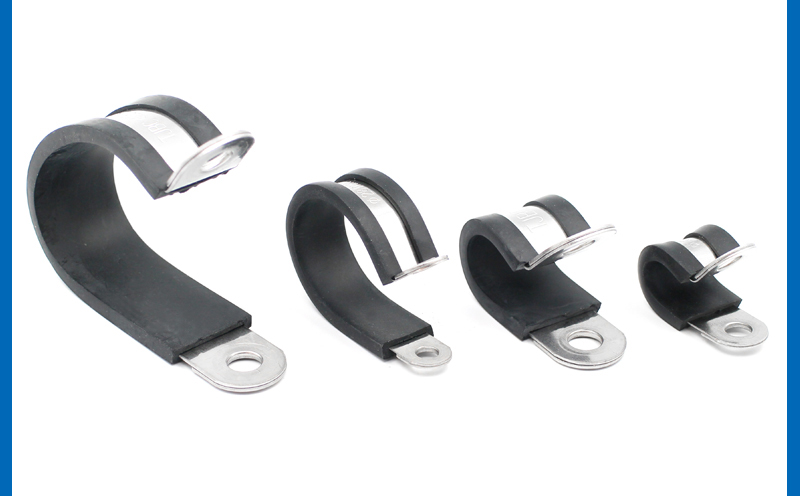
Materials: High-damping elastic gaskets such as rubber, silicone rubber, and metal rubber inside the clamp.
Mechanism:
Vibration Conversion: Pipeline vibration → repeated compression, shear, and stretching deformation of the gasket.
Energy Dissipation: Molecular friction inside the material and interface friction between the material and the pipeline wall/clamp convert kinetic energy into thermal energy for dissipation.
Transmission Blocking: Form an elastic layer to prevent vibration from propagating from the pipeline to the bracket/wall, or from the equipment to the pipeline.
Allow axial expansion and contraction, radial offset, and small-angle deflection of the pipeline (three-way flexibility).
Absorb displacements caused by thermal expansion and contraction, equipment vibration, and foundation settlement, and avoid stress concentration and resonance amplification.
Traditional welding/flanges are rigid connections (resisting stress rigidly); clamps adopt a flexible approach to overcome rigidity (vibrations are buffered and absorbed).
Metal Clamps: Provide uniform radial clamping to ensure the gasket remains attached and does not loosen.
Gap/Groove Design: A small gap is reserved at the pipeline end to further block the linear propagation of structure-borne sound and vibration waves.
Reduce Vibration Transmission Rate
Significantly reduce the propagation of equipment vibrations (such as pumps, compressors, and fans) along the pipeline.
Reduce pipeline resonance, lower pipeline stress, and prevent fatigue fracture.
Noise Reduction (Structure-Borne Sound Isolation)
Block structure-borne noise (pipeline vibration → bracket → wall → indoor noise).
Significant noise reduction effect for pipelines in machine rooms, pump rooms, and buildings.
Protect Pipelines and Equipment
Buffer impact, water hammer, and pulsation to protect welds, valves, and instruments.
Extend the service life of pipelines, seals, and equipment.
Adapt to Dynamic Working Conditions
Suitable for scenarios with vibration, settlement, thermal expansion, and displacement (subways, bridges, ships, high-rises).
Clamps with Rubber Gaskets (Standard Vibration Isolation): Metal clamp body + nitrile/EPDM/silicone rubber gasket (most commonly used).
Metal Rubber Clamps (High Temperature/Heavy Load): Porous sintered metal wire material, dry friction damping, high and low temperature resistance, and long service life.
Clamp-Type Flexible Pipe Joints (Grooved Type): C-type/O-type rubber ring + two-piece clamp, integratingconnection + vibration isolation + compensation.
Damping Hoops/Particle Damping Clamps: Built-in damping particles for multi-dimensional and efficient vibration reduction (strong damping at medium and low frequencies).
Building Water Supply and Drainage, Fire Protection: Vibration isolation and noise reduction for pump rooms and risers
HVAC Air Conditioning Water Pipes/Air Ducts: Vibration isolation for fans and water pumps
Marine/Offshore Engineering: Wave vibration and salt spray environment
Aerospace Hydraulic Pipes: High damping and resistance to vibration fatigue
Automotive/Construction Machinery: Shock absorption and anti-loosening for engines and pipelines
Chemical/Petroleum: High temperature, corrosion, and pulsation working conditions
Characteristics | Clamps (Flexible/With Gasket) | Welding/Flanges (Rigid Connections) |
Vibration Transmission | Low (high vibration isolation rate) | High (direct transmission) |
Displacement Compensation | Three-way (axial/radial/angular) | None (prone to stress cracking) |
Noise Reduction | Excellent (structure-borne sound blocking) | Poor (resonance amplification) |
Earthquake/Settlement Resistance | Good (toughness buffering) | Poor (brittle fracture) |
Gasket Material: Damping coefficient, hardness, temperature/medium resistance (nitrile, EPDM, silicone rubber, metal rubber).
Preload: Loose preload leads to failure; excessive preload crushes the elastic layer (losing vibration isolation effect).
Clamp Spacing: The longer the pipeline and the greater the vibration, the denser the spacing (denser support results in less vibration).
Structural Form: Flexible > Rigid; With gasket > Without gasket.
address
No 19, Guanghai Road, Jinghai new
economic developed zone, Tianjin city
telephone
86-022-68771238
86-022-68772466
86-022-68771191
tjbc@tjbchg.com